Local Zambian Child Receives 135 millionth PermaNet® Bed Net
Vestergaard Frandsen, a world leader in the development of disease-control textiles, observed the first-ever World Malaria Day with a series of events in Livingstone, Zambia on April 24 and 25, 2008.
In collaboration with the Roll Back Malaria Partnership (RBM), Vestergaard Frandsen participated in a press conference in Livingstone, Zambia to profile the Zambezi Expedition, a two-month tour of countries in Africa designed to demonstrate that coordinated cross-border strategies and actions will prove successful in the fight against malaria.
The theme for World Malaria Day is “malaria: a disease without borders.” In recognition of this observation and in celebration of the company’s commitment to defeat malaria, VF staff will presented their 135 millionth PermaNet® brand bed net to a local child in the pediatric ward of the Livingstone Hospital. Additionally, all children at the hospital were given free PermaNet® bed nets on April 24th.
The donation of the 135 millionth PermaNet® demonstrates the success that Vestergaard Frandsen has made in scaling-up production to meet the growing needs of people at risk for contracting malaria in the developing world.
“We are proud to be official sponsors of the Zambezi Expedition, and its role in attracting worldwide attention to both the malaria crisis and the preventable nature of this disease,” said Mikkel Vestergaard Frandsen, CEO of Vestergaard Frandsen. “I firmly believe that the global burden of malaria calls for a global response, and cross-border strategies provide the best approach to beating malaria and insuring a brighter future for all of Africa’s children. By increasing production of our lifesaving PermaNet® product, Vestergaard Frandsen has bridged the global LLIN supply-gap, saving countless pregnant mothers and children from the ravages of malaria.”
The press conference was also meant to draw attention to the Zambezi Expedition, which passes through Livingstone during World Malaria Day. Sponsored by the SADC and other RBM partners, the Expedition was launched on 27 March 2008 and will navigate its way through Angola, Zambia, Namibia, Botswana, Zimbabwe and Mozambique. It will stop in each country to take on board local malaria control staff and journalists for a fact-finding tour of remote river communities exposed daily to life-threatening malaria-carrying mosquitoes. By highlighting both successes and challenges of fighting malaria in these six countries, the Expedition aims to demonstrate that only coordinated cross- order strategies and actions will prove successful in the fight against malaria.
The Expedition will distribute donated PermaNet® brand bed nets in Zambia, Zimbabwe and Mozambique.
Malaria kills more than a million people worldwide each year—90 percent of them in Africa, and 70 percent children under the age of five. While being a preventable and treatable disease, malaria causes loss of income and productivity on a scale large enough to slow a country’s economic growth. In such context, World Malaria Day will be a major opportunity for malaria-free countries to learn about the devastating consequences of the disease, for new donors to join a global partnership in the fight and for the scientific community to illustrate advances to both experts and the public.
Vestergaard Frandsen: Vestergaard Frandsen is an international company specializing in complex emergency response and disease control products. The company operates under a unique Humanitarian Entrepreneurship business model. This “profit for a purpose” approach has turned humanitarian responsibility into its core business. Vestergaard Frandsen was founded in Denmark in 1957. From its humble beginning weaving synthetic fabrics for use in work-wear, the company has evolved into a multinational leader focused on helping to achieve the UN’s Millennium Development Goals. For more information please visit: www.vestergaard-frandsen.com.
For more information about the Zambezi Expedition please visit: http://www.zambezi-expedition.org/index.html
For more information about the Roll Back Malaria Partnership please visit: http://www.rbm.who.int/


Trashe Bolsas Bags – Product Review
 Brilliant Recycled Bags
by Michael Smith (Veshengro)
In the Philippines giant billboards promoting all manner of products and services line the highways. In offices, schools, hotels and shops, banners do the same.
Some of those advertising banners, as far as I can see from some photos that I have seen, are extremely large, much like the huge electronic billboards found in the USA and other countries, and often are the size of walls.
These billboards and banners are printed onto tarpaulins or ‘tarps’ made from canvas coated with polycarbonate.
These tarps, designed to withstand the scorching heat and torrential rain of the tropics, are non-biodegradable.
When the tarps are finished with, they either end up in landfill or are burned, thus releasing harmful greenhouse gases – either way, they contribute to an ever increasing threat to the environment.
Trashe Bolsas is a Livelihood Project that operates within the Earth Day Network, an NGO whose aim is to raise awareness of environmental issues.
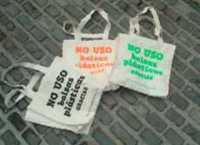
Trashe Bolsas transforms used tarps into unique, strong, durable bags giving an income to women living the temporary housing an income, enabling them to become independent.
I met the two ladies and founders who are the moving force behind this project at the recent Promotional Marketing Exhibition in London and had the opportunity and great pleasure to talk with them, see the bags and take a sample home with me.
All bags are cut out from patterns individually by hand and are then individually sewn on sewing machines by the women in the project, many of who have only recently learned how to sew and especially how to sew using a sewing machine.
For that being the case I have to say that I found the quality of the stitching rather good, especially given also that material such as this used is difficult to sew at the best of time and even by professionals with industrial machines.
As the bags are made from advertising banners are all unique and vary in colors. No two bags will ever, I should think, be alike. This means that while this or that bag may be this or that color on the website it does not mean that the bag you order may be the same color. This is something that must be understood and, in my view, makes those bags so great. Any bag anyone may buy from Trashe Bolsas is different and everyone will be getting a unique one of article.
I can but recommend anyone to purchase one (or more than one) of those unique and wonderful bags.
Check out their website at: http://www.trashebolsas.com
© M Smith (Veshengro), Tatchipen Media & Trashe Bolsas, April 2008

London Olympics of 2012 'will not benefit' East London's poorest residents
by Michael Smith (Veshengro)
As I have basically predicted concerning the Olympics and the poorer and underprivileged people of that area a study now shows that there will be little if any benefit for the poorest residents of East London.
While the Olympic ministers and all those are telling the world what great benefits the locals will have from this, this is all a load of hogwash, as usual, and they know and knew this very well.
The so-called “trickle down” effect does NOT work and never ever has worked.
The 2012 London Olympics will fail to leave the promised positive local legacy for the poorest residents of East London unless cast-iron guarantees are built into plan, according to a new study.
The Games have been presented by the Government and the Olympic delivery bodies as a once-in-a-lifetime opportunity to help regenerate one of the UK’s most economically disadvantaged areas, London’s Lower Lea Valley.
But the Fool's Gold report by the New Economics Foundation (nef) claims that previous Olympics and other ‘flagship’ UK regeneration projects, whilst boosting international tourism, transport, leisure and telecommunications infrastructure, have failed to improve the lives of the poorest people in host cities.
This is just as we assumed and predicted when it all began, and we can be sure that no good will come of it, no lasting benefit, for the disadvantaged people, especially the young people, of East London. All that is going to happen is that all those venues, that is to say the sporting venues, will become out of reach for any of them to use and, like the Dome, they will either become a white elephant or simply a commercial venture that was paid for, yet again, out of the pockets of the poor men and women in this country, that is to say, the honest taxpayers.
Fool’s Gold identifies the ‘trickle down’ economics that underly the approach to regeneration at the heart of the Olympic bid as the root cause of the problem.
This assumes that investment flowing into deprived areas will stay put. In practice, as nef research has shown, it leaks out to consultants, developers and large companies which are best able to exploit new commercial opportunities.
In other words, the poor residents will get no benefit whatsoever but the rich will get even richer, especially those companies that are making a killing from it already.
Small local enterprises are unable to compete and local people who don’t own their own homes are priced out of the housing market because gentrification inflates the cost of living well above their income levels.
Fool’s Gold identifies clear warning signs that London 2012 may be going in the same direction as previous Games in its failure to live up to regeneration promises:
The enormous debts built up by Olympic delivery will have to be repaid, and the easiest way to do this will be to sell off Olympic land to the highest bidder.
Serious doubt has already been cast on the projections used by the Government to calculate the £1.8 billion to be raised by land sales after the Games to repay public and National Lottery money used to buy land for the Olympic site.
A problem the current slowdown in the housing market will only accentuate, placing yet more pressure on the London Development Agency to maximise revenues.
There also remains the other question as to whether the 2012 Olympics can be held in 2020? Why that question? This is quite simple, methinks, for we have yet to see a project such as this to be finished on time and within the budget.
I would love to be able to, come the time, to report that everything has been finished within the set time frame and with the budget not having overrun and also that the locals have benefited and will be benefiting for many years and decades to come from the new infrastructure and that that has been set up. But, I must say that I am not that optimistic and this report certainly does not make me optimistic in that department at all. In fact the opposite is the case. Not as much as to the fact as them getting all the tings ready; that is not really the issue here anyway, but as to the fact of benefits for the poorest of the residents of East London and, like that report, I am afraid that I cannot see it.
Surprise? No... this is New Labour we are talking about... a pink party that has about as much to do with the real Labour party and a party for the people as the state of Israel has with the Israel of the Torah.
© M Smith (Veshengro), April 2008
As I have basically predicted concerning the Olympics and the poorer and underprivileged people of that area a study now shows that there will be little if any benefit for the poorest residents of East London.
While the Olympic ministers and all those are telling the world what great benefits the locals will have from this, this is all a load of hogwash, as usual, and they know and knew this very well.
The so-called “trickle down” effect does NOT work and never ever has worked.
The 2012 London Olympics will fail to leave the promised positive local legacy for the poorest residents of East London unless cast-iron guarantees are built into plan, according to a new study.
The Games have been presented by the Government and the Olympic delivery bodies as a once-in-a-lifetime opportunity to help regenerate one of the UK’s most economically disadvantaged areas, London’s Lower Lea Valley.
But the Fool's Gold report by the New Economics Foundation (nef) claims that previous Olympics and other ‘flagship’ UK regeneration projects, whilst boosting international tourism, transport, leisure and telecommunications infrastructure, have failed to improve the lives of the poorest people in host cities.
This is just as we assumed and predicted when it all began, and we can be sure that no good will come of it, no lasting benefit, for the disadvantaged people, especially the young people, of East London. All that is going to happen is that all those venues, that is to say the sporting venues, will become out of reach for any of them to use and, like the Dome, they will either become a white elephant or simply a commercial venture that was paid for, yet again, out of the pockets of the poor men and women in this country, that is to say, the honest taxpayers.
Fool’s Gold identifies the ‘trickle down’ economics that underly the approach to regeneration at the heart of the Olympic bid as the root cause of the problem.
This assumes that investment flowing into deprived areas will stay put. In practice, as nef research has shown, it leaks out to consultants, developers and large companies which are best able to exploit new commercial opportunities.
In other words, the poor residents will get no benefit whatsoever but the rich will get even richer, especially those companies that are making a killing from it already.
Small local enterprises are unable to compete and local people who don’t own their own homes are priced out of the housing market because gentrification inflates the cost of living well above their income levels.
Fool’s Gold identifies clear warning signs that London 2012 may be going in the same direction as previous Games in its failure to live up to regeneration promises:
The enormous debts built up by Olympic delivery will have to be repaid, and the easiest way to do this will be to sell off Olympic land to the highest bidder.
Serious doubt has already been cast on the projections used by the Government to calculate the £1.8 billion to be raised by land sales after the Games to repay public and National Lottery money used to buy land for the Olympic site.
A problem the current slowdown in the housing market will only accentuate, placing yet more pressure on the London Development Agency to maximise revenues.
There also remains the other question as to whether the 2012 Olympics can be held in 2020? Why that question? This is quite simple, methinks, for we have yet to see a project such as this to be finished on time and within the budget.
I would love to be able to, come the time, to report that everything has been finished within the set time frame and with the budget not having overrun and also that the locals have benefited and will be benefiting for many years and decades to come from the new infrastructure and that that has been set up. But, I must say that I am not that optimistic and this report certainly does not make me optimistic in that department at all. In fact the opposite is the case. Not as much as to the fact as them getting all the tings ready; that is not really the issue here anyway, but as to the fact of benefits for the poorest of the residents of East London and, like that report, I am afraid that I cannot see it.
Surprise? No... this is New Labour we are talking about... a pink party that has about as much to do with the real Labour party and a party for the people as the state of Israel has with the Israel of the Torah.
© M Smith (Veshengro), April 2008
Nazi tactics of the Israeli Security Forces
Nazi-style collective punishment tactics used by Israel against Gaza civilians.
by Michael Smith (Veshengro)
After an incursion of Israeli military into the Gaza strip and while those forces, after wreaking havoc were withdrawing, they came into an ambush by Hamas fighters. During the ensuing firefight 3 IDF soldiers were killed.
In retaliation for this Israel, in its usual Nazi tactics, launched air strikes up and down the Gaza border against civilian targets, though obviously the Israeli military and government yet again claim that they were attacking only terrorist strongholds.
This smacks very much of the way the German Fascist war machinery acted against the civilian population of occupied countries as and when partisans and resistance fighters fought with the Nazi military or had attacked some infrastructure targets.
So Hamas partisans and resistance fight against the incursions by Israel occupation forces into the Gaza strip and the Israelis retaliate with Nazi methods against the civilian population of Gaza. This is nothing but collective punishment. The same kind of collective punishment that was so favored by the German Nazis in their fight against partisans and resistance fighters.
And Israel still maintains and claims that this is not something that is akin to the collective punishment tactics of the Nazis who, supposedly, killed six million Jews.
I am afraid to say that it is, it is the very same tactics that the Nazis used and in using such tactics against the population, the ordinary Palestinians, men, women and children and the old, Israel is no better than Nazi Germany of that dark era in the 20th century. What Israel is doing is exactly the same as what the Nazis did and it is genocide.
I think, and I am sure that I am not alone here, that the Western governments should rethink in the way they interact with Israel and the so-called Jewish state. This is no way that a free and democratic country, which Israel claims to be, should act.
While the West is always very quick to boycott countries, be this trade sanction or diplomatic sanctions, that oppress their population, as has been done in the case of Zimbabwe – though they seem to be unwilling to do more – when it comes to Israel, which is not better, as in fact the ones oppressed are firstly not even in their country but on territory illegally occupied or reoccupied – if even for a few hours or days, in the fight against terrorism, supposedly – they are not even willing to condemn such actions against the Palestinians in any way shape or form. Talk of double standards. Surprising it probably should not be seeing the influences and lobby that the supporters of Israel, in the form of the Jews themselves and then those Christians that could not be more pro-Israel if they even tried because they believe that the “rebuilding” of Israel heralds the imminent Second coming of the Christ, who supposedly is the Messiah. Politicians in the Western world just do not dare to say anything too powerful or act against Israel as they might just lose the support of those powerful voters. It has nothing to do with ethics but all to do with power.
So, if the politicians are not willing to do anything maybe then people power is required. If no official sanctions and trade boycotts then it is up to us as ethical shoppers to boycott as and wherever possible Israeli goods and services, and may be more than just Israeli goods and services. Maybe including the services of any other supporters of the illegal state of Israel (and I do not care that that state has been officially accepted by the UN at that time). Israel is founded on stolen land.
© M Smith (Veshengro) & Tatchipen Media, April 2008
by Michael Smith (Veshengro)
After an incursion of Israeli military into the Gaza strip and while those forces, after wreaking havoc were withdrawing, they came into an ambush by Hamas fighters. During the ensuing firefight 3 IDF soldiers were killed.
In retaliation for this Israel, in its usual Nazi tactics, launched air strikes up and down the Gaza border against civilian targets, though obviously the Israeli military and government yet again claim that they were attacking only terrorist strongholds.
This smacks very much of the way the German Fascist war machinery acted against the civilian population of occupied countries as and when partisans and resistance fighters fought with the Nazi military or had attacked some infrastructure targets.
So Hamas partisans and resistance fight against the incursions by Israel occupation forces into the Gaza strip and the Israelis retaliate with Nazi methods against the civilian population of Gaza. This is nothing but collective punishment. The same kind of collective punishment that was so favored by the German Nazis in their fight against partisans and resistance fighters.
And Israel still maintains and claims that this is not something that is akin to the collective punishment tactics of the Nazis who, supposedly, killed six million Jews.
I am afraid to say that it is, it is the very same tactics that the Nazis used and in using such tactics against the population, the ordinary Palestinians, men, women and children and the old, Israel is no better than Nazi Germany of that dark era in the 20th century. What Israel is doing is exactly the same as what the Nazis did and it is genocide.
I think, and I am sure that I am not alone here, that the Western governments should rethink in the way they interact with Israel and the so-called Jewish state. This is no way that a free and democratic country, which Israel claims to be, should act.
While the West is always very quick to boycott countries, be this trade sanction or diplomatic sanctions, that oppress their population, as has been done in the case of Zimbabwe – though they seem to be unwilling to do more – when it comes to Israel, which is not better, as in fact the ones oppressed are firstly not even in their country but on territory illegally occupied or reoccupied – if even for a few hours or days, in the fight against terrorism, supposedly – they are not even willing to condemn such actions against the Palestinians in any way shape or form. Talk of double standards. Surprising it probably should not be seeing the influences and lobby that the supporters of Israel, in the form of the Jews themselves and then those Christians that could not be more pro-Israel if they even tried because they believe that the “rebuilding” of Israel heralds the imminent Second coming of the Christ, who supposedly is the Messiah. Politicians in the Western world just do not dare to say anything too powerful or act against Israel as they might just lose the support of those powerful voters. It has nothing to do with ethics but all to do with power.
So, if the politicians are not willing to do anything maybe then people power is required. If no official sanctions and trade boycotts then it is up to us as ethical shoppers to boycott as and wherever possible Israeli goods and services, and may be more than just Israeli goods and services. Maybe including the services of any other supporters of the illegal state of Israel (and I do not care that that state has been officially accepted by the UN at that time). Israel is founded on stolen land.
© M Smith (Veshengro) & Tatchipen Media, April 2008
Let's hear it for the South African Dockworkers
by Michael Smith (Veshengro)
It would appear that in South Africa and Southern Africa the only people willing to stand up against the tyrant Robert Mugabe in Zimbabwe are the “little” people in that region, in this case ordinary dockworkers and, it would appear also, the police of the port of Durban. The former for refusing to unload the Chinese vessel with a cargo of weapons bound for the security forces of Zimbabwe and sending the vessel packing again and the latter for not enforcing the unloading of said ship.
The vessel is now, so it would appear, headed for the port of the Angolan capital. Let us just hope that dockworkers and other there have the same courage to refuse to unload the ship.
If the rest of the dockers in the area where the ship could dock to unload and police would do the same, that is to say, refuse to let the cargo be unloaded then sooner or later the ship will have no option as to return with its cargo as undelivered come undeliverable.
While food and other “humanitarian” shipments should not be boycotted, anything that could aid the dictator and his clique in Zimbabwe should be blocked from ever reaching the country. It cannot be that difficult.
It is rather a shame and a shame on them that the politicians in that region just do not have the same courage and the same ethics as do “ordinary” workers and even police officers and their commanders. The politicians of SADEC and the other African political bodies and especially the leaders in the neighboring countries, with President Tabo Mbeke in the forefront, should be ashamed and should go and do penance.
So, let's hear it for the dockers of the port of Durban and their Union and also for the police that did not interfere in the name of “free commerce”.
© M Smith (Veshengro)
It would appear that in South Africa and Southern Africa the only people willing to stand up against the tyrant Robert Mugabe in Zimbabwe are the “little” people in that region, in this case ordinary dockworkers and, it would appear also, the police of the port of Durban. The former for refusing to unload the Chinese vessel with a cargo of weapons bound for the security forces of Zimbabwe and sending the vessel packing again and the latter for not enforcing the unloading of said ship.
The vessel is now, so it would appear, headed for the port of the Angolan capital. Let us just hope that dockworkers and other there have the same courage to refuse to unload the ship.
If the rest of the dockers in the area where the ship could dock to unload and police would do the same, that is to say, refuse to let the cargo be unloaded then sooner or later the ship will have no option as to return with its cargo as undelivered come undeliverable.
While food and other “humanitarian” shipments should not be boycotted, anything that could aid the dictator and his clique in Zimbabwe should be blocked from ever reaching the country. It cannot be that difficult.
It is rather a shame and a shame on them that the politicians in that region just do not have the same courage and the same ethics as do “ordinary” workers and even police officers and their commanders. The politicians of SADEC and the other African political bodies and especially the leaders in the neighboring countries, with President Tabo Mbeke in the forefront, should be ashamed and should go and do penance.
So, let's hear it for the dockers of the port of Durban and their Union and also for the police that did not interfere in the name of “free commerce”.
© M Smith (Veshengro)
TUC welcomes South African union action on Zimbabwe
Commenting on the refusal by South African dock workers to unload a shipment of arms destined for Zimbabwe's armed forces, TUC General Secretary Brendan Barber said: 'While others just talk about Zimbabwe, unions in South Africa are actually doing something.
'The dock workers' refusal to unload arms destined for Mugabe's thugs is a positive move. It should shame politicians around the region to stop talking and start acting on Zimbabwe's crisis.
'The TUC supports fully the South African trade union movement's practical solidarity with Zimbabwe's trade unions.'
'The dock workers' refusal to unload arms destined for Mugabe's thugs is a positive move. It should shame politicians around the region to stop talking and start acting on Zimbabwe's crisis.
'The TUC supports fully the South African trade union movement's practical solidarity with Zimbabwe's trade unions.'
Subscribe to:
Posts (Atom)